

... that I miss most about Korea!
5. Hearing a mixture of k-pop and 90s pop music a-la the Backstreet Boys playing in most coffee shops and restaurants.
4. Free internet available in any and every open public space.
3. Cutesy dancing, cartoons and costumes being considered appropriate for any and all situations (remember, this includes campaigning for national elections).
2. Getting in my daily dose of kimchi. Ridiculously addicting.
And last but DEFININTELY not least,
1. The PEOPLE.
I will carry with me forever from my first year in Korea memories and friendships that have left a permanent mark on my heart. Everyone from my co-workers and my precious students, to the people that I volunteered with, to the friends and family members who became my network of love and support for my time overseas-- even down to the couple who ran the corner store down the street from my apartment, and the lady who spoke perfect English at the bank-- meant so much to me. Each in their own way played a special role in God's shaping, challenging and changing me over the past year, and I am so thankful to Him for bringing them into my life, and for allowing me to be a small part of theirs.
Showing posts with label Language and Culture. Show all posts
Showing posts with label Language and Culture. Show all posts
Tuesday, August 17, 2010

Friday, July 16, 2010
Sweet tea, pecan pie and homemade wine

"In the South, the breeze blows softer...neighbors are friendlier, nosier, and more talkative. (By contrast with the Yankee, the Southerner never uses one word when ten or twenty will do)...This is a different place. Our way of thinking is different, as are our ways of seeing, laughing, singing, eating, meeting and parting. Our walk is different, as the old song goes, our talk and our names. Nothing about us is quite the same as in the country to the north and west."This week, as I begin the process of preparing for the trip back home, I am finding myself getting downright giddy-- not at the thought of being back in the United States, but at the thought of being back in the South. This sentiment has come as a surprise to many of my friends here, who don't necessarily view me as a very stereotypically southern kind of girl. And truthfully, the extent of my longing for the South has come as a bit of a surprise to me as well.
--Charles Kuralt in "Southerners: Portrait of a People"
"All I can say is that there's a sweetness here, a Southern sweetness, that makes sweet music... If I had to tell somebody who had never been to the South, who had never heard of soul music, what it was, I'd just have to tell them that it's music from the heart, from the pulse, from the innermost feeling. That's my soul; that's how I sing. And that's the South."
--Al Green
But southern culture is COMFORT to me. Its what I associate with a sense of HOME. And there is nothing like travel to bring that appreciation and sense of belonging to light. Southern summers have grown idyllic in my memory. Nights spent under the stars on Carolina beaches, country music concerts on the lawn at Walnut Creek, barn parties, family reunions, and barbecues (the kind where you smoke a whole pig and gather everyone you know to help you eat it)-- where cold beer, smiles, and slow conversation are always available in plenty... my heart feels at home there.
My grandparents are currently in the process of putting all of their old home videos onto DVD. They recently sent me footage of the first few years of my life in a care package, and it brought back a lot of sweet memories. When he was younger, my granddaddy built a houseboat by hand, and I grew up spending the majority of my summers doing back flips off its front porch. In a movie of my life, this Craig Morgan song could easily serve as the theme song for my childhood summers.
During the month that I have at home, I have planned to cram in as many of these kinds of uniquely and stereotypically southern activities as I possibly can. These plans include a trip to the Andy Griffith museum in Mount Airy (aka Mayberry) and a Zac Brown Band concert. I only really know one of their songs well, but could any song be more southern than this one?
"What can be more Southern than to obsess about being Southern?"
--Elizabeth Fortson Arroyo
--Elizabeth Fortson Arroyo
Tuesday, June 15, 2010
World Cup Fever

Korea’s got World Cup fever… bad. Back in 2002, Korea had the honor of hosting the Cup AND placing 4th. Since then, the nation has been a particularly soccer crazy one—and I am completely loving every minute of it! I was in China for the last World Cup, in Jordan for the 2008 Euro Cup, and am now experiencing this year’s World Cup in Korea—- and though I’ve haven’t exactly been planning it out that way, I am starting to think I should turn this into a tradition, because it really is GREAT being in a country that actually *cares* about soccer for this event!
Soccer and the excitement of the World Cup, perhaps more than any other single sport, truly brings the world together. But, being from the one country who doesn’t share the rest of the planet’s intense love and passion for the game, I have always felt a bit excluded from that experience. Because while Korea has pop stars and Olympian figure skaters getting together to make special songs just for the event...
....we in American have Stephen Colbert making this:
| The Colbert Report | Mon - Thurs 11:30pm / 10:30c | |||
| Sport Report - Soccer Debate - Marc Fisher & Mark Starr | ||||
| ||||
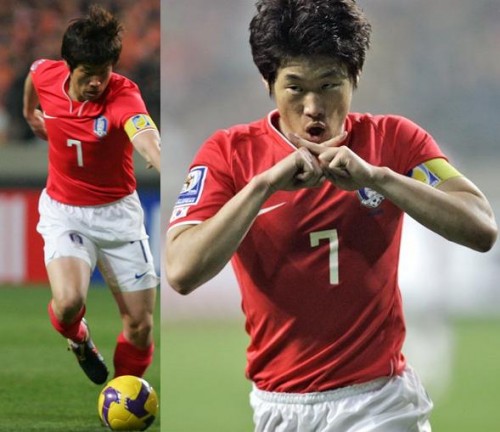
I personally have always gotten really into the games—and the emotional intensity surrounding me here only fuels my longstanding love for the sport. The US’s lucky draw with England completely wore down my nerves (and kind of made me want to punch things at times), while Korea’s upset over Greece was really exciting, and had me, along with the rest of Korea, feeling pretty elated. Random shouts of “DAE HAN MIN GUK!!” and “KOREA FIGHTING!” could be heard from *literally* every street corner that night, and not at all infrequently even in the days that followed. Ji-Sung Park, the super energetic 5’9” Manchester United midfielder who all of the Korean girls go ga-ga for, and all of the Korean boys aspire to be, is arguably the most loved and revered person in this country right now.
The most personally significant thing about this whole experience for me, though, has been my coming to the realization in watching the first round that I have developed the same sense of ownership and feelings of pride towards Korea’s national team that I feel towards the US. It has made me recognize just how attached and connected I have become to my mother’s homeland in my time here—which is great, because that’s exactly what I had hoped would begin to happen when I made the decision to come.
...And in other related news, I told my students that if any of them could learn this dance and perform it for me before the World Cup is over I would give them a big prize.
No one has taken me up on it yet, but I *have* spotted a few groups of kids practicing :P
Korea fighting!!! v(^_^)v
Friday, June 11, 2010
Babies, Weddings, and Funerals
Seems that lots of monumental events have been happening in the lives of those around me here in Korea lately.
Two close friends of mine have recently gotten engaged and are getting married in just two short months. They came to Korea around the same time I did and met one another here, so I have had the opportunity to witness their relationship from the very beginning, and it's really special. Another two friends of mine-- a really great couple from Nigeria-- are expecting their first baby soon. And, in addition to experiencing the excitement involved in planning for bachelorette excursions and baby showers with my foreign friends, I've recently also had the opportunity to experience both the joy of a wedding and the sadness of a funeral in the lives of two of my Korean coworkers.
I've gotten a lot of questions about these last two events in particular, and it might disappoint some of you to hear me report that there is not much of a difference between a Korean wedding and an American one. Nor is there much of a difference between a Korean funeral and an American one. Undoubtedly this is largely due to the recent westernization of the Korean hemisphere, but I also think that, more significantly and on a more fundamental level, weddings and funerals the world over have certain qualities about them that are simply universal.
For instance, western countries and other "modernized" nations like Korea may tend to emphasize a movie-like version of romantic love in marriage, while other peoples do not believe that to be the institution's main purpose, but I have never heard of a culture in which a wedding does not represent on some level the satisfaction of a human longing for relationship and connectivity. Whether this is framed on the individual level, or on a familial or even communal level, it is still something that rings true throughout every society and culture. Likewise, a funeral-- whether it is done by viewing the body as in the US, cremating it as in India, or by bowing respectfully before a photo of the deceased (no dead bodies involved) as in Korea-- is always a way for the living to process death. Death is a part of all our lives, and it is a universally difficult, complex, and transcendent experience that needs navigating.
I imagine that no matter where in the world I travel, weddings and funerals will never be so foreign as to fail to reflect these two aspects of human need and experience. And all the rest is mere packaging and fluff. It may be beautiful packaging and the differences may be exciting to learn about-- certainly a joy to embrace and experience. But for me, the most beautiful experience of all, and the one worth traveling the world over to have, is to stand in a crowd and feel the same joy and mourning reflected across every kind of linguistic and cultural boundary that should to divide us, and to know that it is our shared identity as images of our Creator that connects our hearts.
Two close friends of mine have recently gotten engaged and are getting married in just two short months. They came to Korea around the same time I did and met one another here, so I have had the opportunity to witness their relationship from the very beginning, and it's really special. Another two friends of mine-- a really great couple from Nigeria-- are expecting their first baby soon. And, in addition to experiencing the excitement involved in planning for bachelorette excursions and baby showers with my foreign friends, I've recently also had the opportunity to experience both the joy of a wedding and the sadness of a funeral in the lives of two of my Korean coworkers.
I've gotten a lot of questions about these last two events in particular, and it might disappoint some of you to hear me report that there is not much of a difference between a Korean wedding and an American one. Nor is there much of a difference between a Korean funeral and an American one. Undoubtedly this is largely due to the recent westernization of the Korean hemisphere, but I also think that, more significantly and on a more fundamental level, weddings and funerals the world over have certain qualities about them that are simply universal.
For instance, western countries and other "modernized" nations like Korea may tend to emphasize a movie-like version of romantic love in marriage, while other peoples do not believe that to be the institution's main purpose, but I have never heard of a culture in which a wedding does not represent on some level the satisfaction of a human longing for relationship and connectivity. Whether this is framed on the individual level, or on a familial or even communal level, it is still something that rings true throughout every society and culture. Likewise, a funeral-- whether it is done by viewing the body as in the US, cremating it as in India, or by bowing respectfully before a photo of the deceased (no dead bodies involved) as in Korea-- is always a way for the living to process death. Death is a part of all our lives, and it is a universally difficult, complex, and transcendent experience that needs navigating.
I imagine that no matter where in the world I travel, weddings and funerals will never be so foreign as to fail to reflect these two aspects of human need and experience. And all the rest is mere packaging and fluff. It may be beautiful packaging and the differences may be exciting to learn about-- certainly a joy to embrace and experience. But for me, the most beautiful experience of all, and the one worth traveling the world over to have, is to stand in a crowd and feel the same joy and mourning reflected across every kind of linguistic and cultural boundary that should to divide us, and to know that it is our shared identity as images of our Creator that connects our hearts.
Friday, June 4, 2010
The New Dork
The Korea Times posted an article yesterday touting Twitter as a significant force in this week's elections. While I knew that Korean people knew about Twitter, because I have often been asked if I was on it-- usually before being barraged with questions about Obama-- I didn't know that many Korean nationals actually use the site. Though the article seemed to possibly be overstating the case-- a 400,000 person presence on Twitter significantly turned the outcome of elections?-- it brought me back mentally to 2008 in the US and to the feeling of familiarity and home.
I suppose, though, that I shouldn't have been as struck by this as I was. After all, one of the top 3 aspects of Korean culture that foreigners here name as most notable is TECHNOLOGY. I was initially surprised when I learned this-- I probably would have said something about kimchi, or the Korean work ethic myself-- but that is probably just because I am completely technologically challenged and so do not have my eyes open to that sort of thing; my grandparents and I relate well when it comes to stuff like computers and text messages. With a little research, however, I came to learn that Korea is in fact the seventh most wired country in the world, and is ranked second only to Hong Kong in Asia according to Forbes magazine, which doles out its rankings not only on based on tech-usage, but tech-friendly government policies. So it seems that Korea and technology experience a mutual loving relationship.
I have certainly seen this mutual embrace reflected by my students. These kids are all about their computer games. It is literally all they claim to do, aside from study, sleep and eat. In my classes, it has even gotten to the point that anytime I am teaching a lesson related to hobbies, I qualify that speaking about computer games is off limits, just so they have the opportunity to learn some new vocabulary. Even so, their resolve to talk about computers is unshakable. Today, I asked a student what kind of house he wanted to have when he grew up, and he answered that he wanted a house with four P.C. rooms devoted solely to gaming. At home, a statement like that might have earned that student a few less-than-kind snickers, but here it garnered a roomful of enthusiastic nods of agreement.
I'm always looking for ways to harness this enthusiasm for technology to excite the students about English. Recently, I've been translating songs into text lingo and having them compete to decode the songs and guess the name of the artist. I've also come across this remake of Empire State of Mind called The New Dork- Entrepreneur State of Mind. The students in my advanced classes completely get a kick out of it, because the lyrics all refer to a world they can relate to well.
I suppose, though, that I shouldn't have been as struck by this as I was. After all, one of the top 3 aspects of Korean culture that foreigners here name as most notable is TECHNOLOGY. I was initially surprised when I learned this-- I probably would have said something about kimchi, or the Korean work ethic myself-- but that is probably just because I am completely technologically challenged and so do not have my eyes open to that sort of thing; my grandparents and I relate well when it comes to stuff like computers and text messages. With a little research, however, I came to learn that Korea is in fact the seventh most wired country in the world, and is ranked second only to Hong Kong in Asia according to Forbes magazine, which doles out its rankings not only on based on tech-usage, but tech-friendly government policies. So it seems that Korea and technology experience a mutual loving relationship.
I have certainly seen this mutual embrace reflected by my students. These kids are all about their computer games. It is literally all they claim to do, aside from study, sleep and eat. In my classes, it has even gotten to the point that anytime I am teaching a lesson related to hobbies, I qualify that speaking about computer games is off limits, just so they have the opportunity to learn some new vocabulary. Even so, their resolve to talk about computers is unshakable. Today, I asked a student what kind of house he wanted to have when he grew up, and he answered that he wanted a house with four P.C. rooms devoted solely to gaming. At home, a statement like that might have earned that student a few less-than-kind snickers, but here it garnered a roomful of enthusiastic nods of agreement.
I'm always looking for ways to harness this enthusiasm for technology to excite the students about English. Recently, I've been translating songs into text lingo and having them compete to decode the songs and guess the name of the artist. I've also come across this remake of Empire State of Mind called The New Dork- Entrepreneur State of Mind. The students in my advanced classes completely get a kick out of it, because the lyrics all refer to a world they can relate to well.
Tuesday, June 1, 2010
Election Day
Two more days off of work this week. It's kind of strange having so many teaching days canceled so close together-- and inconvenient, since we are nearing the end of the semester and there doesn't ever quite seem to be enough time to accomplish all that is required. But, given how busy I am right now both at work and with other responsibilities, it has been helpful in a way to get a little bit of time to devote to planning, prioritizing and organizing. I feel a bit more on top of things, and not as much like I am playing catch-up.
Another perk of the vacation days-- they mark the end of Korea's very... um, Korean?... campaigning process for local elections. Tomorrow is Election day (by the way, try saying that with a Korean accent-- l's are r's-- and that's what I've been hearing all week), which is treated as a national holiday, giving everyone the day off in order to take away any excuse not to vote.
Election season is much shorter here than what we experience in the US, but it packs a bit more of a punch. For the past few weeks, every street corner, subway station and open public space has been filled with people, mostly middle-aged, in various *matching neon-colored outfits* doing *choreographed dances and cheers* in front of giant screens that display the face of their chosen candidate. Yep. I'm really sorry I don't have pictures or video to share this phenomenon with you, but if you are picturing it and it looks more than slightly ridiculous, you are probably imagining it correctly. Now add to that image fleets of oddly designed colorful trucks that drive up and down the streets blaring music and rhetoric, most often manned by a pair of women-- dressed of course in their candidate's signature color-- riding in the back to dance, wave, smile and bow at every passer-by... and there you have a pretty accurate picture of my daily surrounding for the past month.
I've definitely enjoyed it while it's lasted, and I definitely think I will equally enjoy it when it is over.
:)
UPDATE: Here are a few photos of Korean election campaigners that I stole from a friend. They don't completely give an adequate picture of the phenomenon I described, but they do give a small taste.


Another perk of the vacation days-- they mark the end of Korea's very... um, Korean?... campaigning process for local elections. Tomorrow is Election day (by the way, try saying that with a Korean accent-- l's are r's-- and that's what I've been hearing all week), which is treated as a national holiday, giving everyone the day off in order to take away any excuse not to vote.
Election season is much shorter here than what we experience in the US, but it packs a bit more of a punch. For the past few weeks, every street corner, subway station and open public space has been filled with people, mostly middle-aged, in various *matching neon-colored outfits* doing *choreographed dances and cheers* in front of giant screens that display the face of their chosen candidate. Yep. I'm really sorry I don't have pictures or video to share this phenomenon with you, but if you are picturing it and it looks more than slightly ridiculous, you are probably imagining it correctly. Now add to that image fleets of oddly designed colorful trucks that drive up and down the streets blaring music and rhetoric, most often manned by a pair of women-- dressed of course in their candidate's signature color-- riding in the back to dance, wave, smile and bow at every passer-by... and there you have a pretty accurate picture of my daily surrounding for the past month.
I've definitely enjoyed it while it's lasted, and I definitely think I will equally enjoy it when it is over.
:)
UPDATE: Here are a few photos of Korean election campaigners that I stole from a friend. They don't completely give an adequate picture of the phenomenon I described, but they do give a small taste.


Sunday, May 23, 2010
Happy Birthday Buddha
I think Korea in May has the greatest number of holidays that I have ever experienced in a single month. Not that I'm complaining.
This past Friday we had the day off (once again) for Buddha's birthday-- a very festive day in a country that has historically been largely Buddhist. Around 15-20 percent of the population currently identifies Buddhism as their religion, but the cultural impact of the Buddhist tradition, especially prior to the relatively recent rise of Christianity in Korea, is much more widespread than these numbers suggest. Festivals surrounding this holiday, considered by many Buddhist's to be the most important holiday in their tradition, have lasted the better half of the month-- the largest being Seoul's Lotus Lantern Festival.

I spent most of the day in Samcheon-dong, home to Bongeun Temple, where, as a part of the festival, the monks featured a colorful exhibition of handmade traditional lanterns. The streets in Samcheon-dong have long been my favorite place in Seoul to spend a laid-back afternoon of shopping or just general meandering. The neighborhood is a seamless melding together of historical Korean landmarks, districts and homes with quaint galleries, shops, cafes and restaurants that often give off (what I imagine to be) a rather European feel.

There are also numerous "tea gardens" in the area, which offer the setting of a traditional Korean tea house, while allowing patrons to enjoy the open air and a beautiful view of traditional homes- or even a Joseon-dynasty palace- against the backdrop of low Korean mountains. I soaked in the view while sipping on strawberry flavored "five-taste tea," a sweet drink made from the fruit of the Chinese magnolia vine, chilled and served with ice cubes that had tiny flower buds frozen inside.
It was lovely, and I don't know that I could have come up with a more idyllic way to have spent the holiday. Days like Friday leave me thoroughly convinced that moving into Seoul when I return to Korea would be the right choice for me.
This past Friday we had the day off (once again) for Buddha's birthday-- a very festive day in a country that has historically been largely Buddhist. Around 15-20 percent of the population currently identifies Buddhism as their religion, but the cultural impact of the Buddhist tradition, especially prior to the relatively recent rise of Christianity in Korea, is much more widespread than these numbers suggest. Festivals surrounding this holiday, considered by many Buddhist's to be the most important holiday in their tradition, have lasted the better half of the month-- the largest being Seoul's Lotus Lantern Festival.

I spent most of the day in Samcheon-dong, home to Bongeun Temple, where, as a part of the festival, the monks featured a colorful exhibition of handmade traditional lanterns. The streets in Samcheon-dong have long been my favorite place in Seoul to spend a laid-back afternoon of shopping or just general meandering. The neighborhood is a seamless melding together of historical Korean landmarks, districts and homes with quaint galleries, shops, cafes and restaurants that often give off (what I imagine to be) a rather European feel.
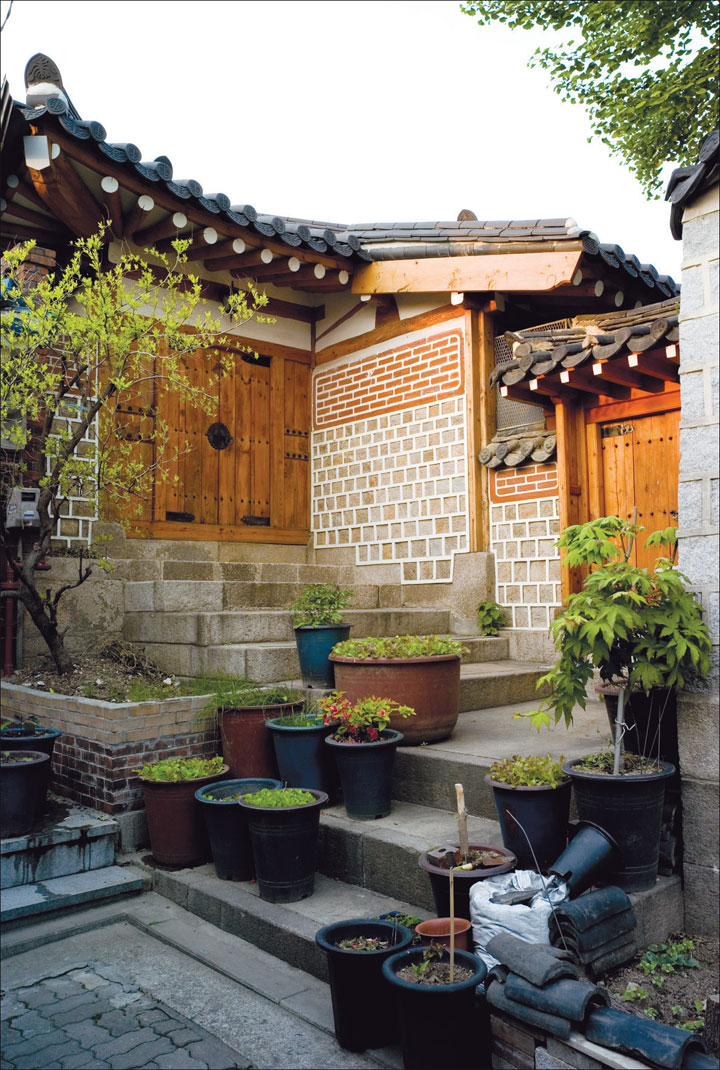
There are also numerous "tea gardens" in the area, which offer the setting of a traditional Korean tea house, while allowing patrons to enjoy the open air and a beautiful view of traditional homes- or even a Joseon-dynasty palace- against the backdrop of low Korean mountains. I soaked in the view while sipping on strawberry flavored "five-taste tea," a sweet drink made from the fruit of the Chinese magnolia vine, chilled and served with ice cubes that had tiny flower buds frozen inside.
It was lovely, and I don't know that I could have come up with a more idyllic way to have spent the holiday. Days like Friday leave me thoroughly convinced that moving into Seoul when I return to Korea would be the right choice for me.
Friday, May 14, 2010
The Dark Underbelly of Teacher's Day

The Month of Family, as May is often referred to in Korea, includes Children's Day, Parent's Day, and finally Teacher's Day on May 15th. The inclusion of teachers in a month set aside to honor the most intimate and foundational of social systems reflects the high regard with which the teaching profession has long been held in Korean society. And while this sentiment may be waning somewhat among younger generations, teachers are still widely acknowledged as one of the most important influences on a young person's development and ability to succeed in life. Teacher's Day is a day set apart to acknowledge the hard work that teachers invest in the future of the nation.
The respect and honor traditionally shown to teachers has, of course, a direct correlation to the extraordinarily high emphasis placed on education in Korea-- something I have mentioned here many times before. And with the exponential rise in educational and professional competition featuring so prominently in South Korea's recent history, it comes as no surprise that this enthusiasm and competitiveness has infiltrated the celebration of Teacher's Day as well.
My extensive Wikipedia research on the subject [;)] returned the following...
Originally [Teacher's Day in Korea] was started by a group of red-cross youth team members who visited their sick ex-teachers at hospitals. The national celebration ceremony had been stopped between 1973 and 1982 and it resumed after that. On the celebration day, teachers are usually presented with carnations by their students, and both enjoy a shorter school day. Ex-students pay their respects to the former teachers by visiting them and handing them a carnation. Many schools now close on Teacher's Day because of the rampant bribery implicit in the expensive gifts often given to teachers.
At my own school, Teacher's Day is treated just as any other school day, a conscious decision having been made to avoid any school-wide celebration or endorsement of the day for exactly the reason mentioned above-- bribery and extravagant gifts have in the past caused scandal and dissension among the parents and within the community.
As a native English-speaking teacher with little say over the children's grades, I am fortunately not impacted by these kinds of politics, and for me it has proved a sweet day. Knowing that they will not see me tomorrow (school is held every other Saturday, but I only work Monday through Friday on any given week), a few of my students have given me gifts of cards, candy, and various little origami creations. They also asked to sing for me in class this morning, and while I know that atleast 80% of their motivation in this was to avoid having to do work for the day, it nonetheless put a smile on my face.
Monday, May 10, 2010
Happy Parent's Day/ Mother's Day!
 Parent's Day in Korea and Mother's Day in the US happen to fall on the same weekend. Parent's Day, as you might have guessed, is essentially like a Mother's Day and Father's Day rolled up into one, and follows only a few days after Children's Day. On Parent's Day, children and adults alike typically present their parents with a gift and a carnation each.
Right now, it is still Mother's Day in the U.S.-- a day I have been looking forward to for the past few weeks. This morning I surprised my mother and grandmother with a video gift of myself singing a traditional Korean song that I have been working hard to learn. (Woohoo! Korean lessons paying off!) I thought of posting the video here, but my rendition is really something that only a mother's ears could love. Instead, I've posted the lyrics and translation below... translates a little awkwardly, but is really a beautiful song and a sweet tribute to a mother's self-sacrificial love.
*Transcript and translation:*
낳실제 괴로움 다잊으시고
She forgets all her pain when she gives birth
기를제 밤 낮으로 애쓰는 마음
She does everything to raise me day and night
진 자리 마른자리 갈아뉘시며
She always finds a warm dry place for me
손발이 다닳도록 고생하시네
She goes through so much hardship in her life
하늘아래 그무엇이 넓다하리요
What would be greater under the sky
어머님의 희생은 가이없어라
Her sacrifice is limitless
P.S. Shout out to my three AMAZING best friends who graduated from UNC today!! Julia, Jamie, and Freda-- so proud and excited for you girls! You are my role models-- can't wait to witness all of the amazing things you are going to do with your futures. The world has no idea what's coming... :) Love, with all my heart!
Sunday, April 25, 2010
Loving Mothers Around the World
Mothers and motherhood have been on my mind a lot lately, for a lot of reasons. Being in Korea definitely has a great deal to do with it. I have come to learn a lot in my time here about the unique challenges and pressures that Confucian ideals place upon the shoulders of women in Korea, especially with regards to family, marriage, and motherhood. On a personal level, the things that I have learned through my time and experiences here have really grown me in love and understanding for my own mother. I've been writing a lot about the life experiences of my mother and grandmother lately, and have spent quite a great deal of time reflecting on the amazing women that have always surrounded me in my family and my life. I feel incredibly grateful and blessed to have had them.
I've also recently been reading a lot about maternal health, maternal mortality, and orphaned children. These issues have really been driving me to my knees. Everything in my being wants to see mothers across the world LIVE, and succeed, and have the opportunity to nurture and care for their children. I deeply admire and wish to honor every woman who loves and sacrifices for her children, wherever and however and to whomever those children first entered the world. My heart rejoices to see mothers (and fathers) rise up and bring orphaned children into their families. I really hope I am blessed to be counted among their ranks one day.
There are other factors, too, at work in promoting my recent preoccupation with motherhood. Like my intention to travel to Haiti in August to work with women and children. And, of course, the fact that Mother's Day in the US is only two weeks away.
This year, I will be celebrating my mother from a distance, and so have been giving special consideration as to how best to show her how much I appreciate her, not only for giving me life, but also for investing in me and loving me unconditionally over the years. I've never been great at giving gifts-- I'd say the worst was probably when I accidentally broke my sister's arm and gave my mom an oh-so-glorious day in the emergency room for Mother's day-- but I'm sure that this year I'll be able to manage something at least a little better than that.
One way that I intend to expand my celebration of Mother's day this year-- and that I invite any who read this to consider-- is by investing in the life of a mother in the developing world who needs some help to provide for and support her family.
One way to do this is through microfinance and the organization that I mentioned in an earlier post, Kiva. In case you aren't familiar, Kiva connects lenders, like you and me, who have modest amounts of expendable income-- even $25-- to business owners in the developing world who need small loans to start-up, grow or expand their small businesses. The majority of small business owners represented on Kiva, I believe, are women; they constitute the group least likely to default on their loans and most likely to allocate resources responsibly. It has been suggested that this gender difference is largely attributable to the value women tend to place on the management, care, education and well-being of their families, and especially their children. In other words, making microloans to mothers is a solid investment, because it's returns are most likely to positively impact children, families and, by extension, whole communities.
For those more moved by maternal health concerns, there is also Compassion International's Child Survival Program. One issue that I have only recently learned about, but that has been weighing heavily on my heart, is that of fistula. An all too common condition plaguing women in the developing world, fistula is a hole in a woman's bladder or rectum that results from sexual assault or, often, obstructed labor. This is a condition that is majorly debilitating and that causes women to be ostracized from their communities. Tragically, MANY of these cases could easily be avoided or repaired simply by the presence of proper medical care during childbirth. The Child Survival Program strives to give women in the developing world access to this kind of care by providing pregnant mothers with skilled birth attendants, who can help ensure safe and healthy deliveries.
These are just a couple ideas to consider-- there are, of course, many other options out there. But I definitely think that programs like the ones mentioned above are powerful ways by which we can celebrate motherhood across the world, as well as demonstrate just how much we value the blood, sweat and tears that so many of our own mother's have so graciously invested in us.
I've also recently been reading a lot about maternal health, maternal mortality, and orphaned children. These issues have really been driving me to my knees. Everything in my being wants to see mothers across the world LIVE, and succeed, and have the opportunity to nurture and care for their children. I deeply admire and wish to honor every woman who loves and sacrifices for her children, wherever and however and to whomever those children first entered the world. My heart rejoices to see mothers (and fathers) rise up and bring orphaned children into their families. I really hope I am blessed to be counted among their ranks one day.
There are other factors, too, at work in promoting my recent preoccupation with motherhood. Like my intention to travel to Haiti in August to work with women and children. And, of course, the fact that Mother's Day in the US is only two weeks away.
This year, I will be celebrating my mother from a distance, and so have been giving special consideration as to how best to show her how much I appreciate her, not only for giving me life, but also for investing in me and loving me unconditionally over the years. I've never been great at giving gifts-- I'd say the worst was probably when I accidentally broke my sister's arm and gave my mom an oh-so-glorious day in the emergency room for Mother's day-- but I'm sure that this year I'll be able to manage something at least a little better than that.
One way that I intend to expand my celebration of Mother's day this year-- and that I invite any who read this to consider-- is by investing in the life of a mother in the developing world who needs some help to provide for and support her family.
One way to do this is through microfinance and the organization that I mentioned in an earlier post, Kiva. In case you aren't familiar, Kiva connects lenders, like you and me, who have modest amounts of expendable income-- even $25-- to business owners in the developing world who need small loans to start-up, grow or expand their small businesses. The majority of small business owners represented on Kiva, I believe, are women; they constitute the group least likely to default on their loans and most likely to allocate resources responsibly. It has been suggested that this gender difference is largely attributable to the value women tend to place on the management, care, education and well-being of their families, and especially their children. In other words, making microloans to mothers is a solid investment, because it's returns are most likely to positively impact children, families and, by extension, whole communities.
For those more moved by maternal health concerns, there is also Compassion International's Child Survival Program. One issue that I have only recently learned about, but that has been weighing heavily on my heart, is that of fistula. An all too common condition plaguing women in the developing world, fistula is a hole in a woman's bladder or rectum that results from sexual assault or, often, obstructed labor. This is a condition that is majorly debilitating and that causes women to be ostracized from their communities. Tragically, MANY of these cases could easily be avoided or repaired simply by the presence of proper medical care during childbirth. The Child Survival Program strives to give women in the developing world access to this kind of care by providing pregnant mothers with skilled birth attendants, who can help ensure safe and healthy deliveries.
These are just a couple ideas to consider-- there are, of course, many other options out there. But I definitely think that programs like the ones mentioned above are powerful ways by which we can celebrate motherhood across the world, as well as demonstrate just how much we value the blood, sweat and tears that so many of our own mother's have so graciously invested in us.
Wednesday, April 21, 2010
Study study study
I'm really working hard these days to improve my Korean. It struck me recently that I will soon have spent a year here, without being able to do much more than introduce myself and give directions to a cab driver in the native language. And that is just sad.
Fortunately, I have an uncle (actually a cousin of my mother's) who agrees with me that this is a major FAIL and has graciously taken it upon himself to tutor me. In exchange for two hours of English "lessons" with me-- he's a movie director, so basically we just read articles about movies and chat about them-- he helps me slowly and awkwardly make my way through a conversational Korean book. He's very patient with me, which I really appreciate, and I'm really grateful to have had this excuse to hang out with him so often in the past couple months-- he's pretty awesome.
Of course, while I'm definitely excited that my Korean is improving, on the flip side, there ARE some perks to NOT knowing the language well. Example: it gives you a great way to keep yourself entertained during those seemingly endless subway rides to and from Seoul...
In addition to studying Korean, I am also trying to brush up on my French and pick up a few phrases in Creole in preparation for my trip to Haiti. My brain is sort of on language overload right now, but I am kind of liking it-- makes me feel a bit more like a world citizen, and a bit less like just another jerky American who expects others to bend to her language needs.
Fortunately, I have an uncle (actually a cousin of my mother's) who agrees with me that this is a major FAIL and has graciously taken it upon himself to tutor me. In exchange for two hours of English "lessons" with me-- he's a movie director, so basically we just read articles about movies and chat about them-- he helps me slowly and awkwardly make my way through a conversational Korean book. He's very patient with me, which I really appreciate, and I'm really grateful to have had this excuse to hang out with him so often in the past couple months-- he's pretty awesome.
Of course, while I'm definitely excited that my Korean is improving, on the flip side, there ARE some perks to NOT knowing the language well. Example: it gives you a great way to keep yourself entertained during those seemingly endless subway rides to and from Seoul...
(posted at eatyourkimchi.com-- if you're living in Korea, a great site to check out)
In addition to studying Korean, I am also trying to brush up on my French and pick up a few phrases in Creole in preparation for my trip to Haiti. My brain is sort of on language overload right now, but I am kind of liking it-- makes me feel a bit more like a world citizen, and a bit less like just another jerky American who expects others to bend to her language needs.
Sunday, March 14, 2010
White Day
Yet another in a long string of relationship-related holidays in Korea, today was White Day-- the day guys finally reciprocate the affection showered on them this same time last month.

Ahh, so much commercialized love all around.
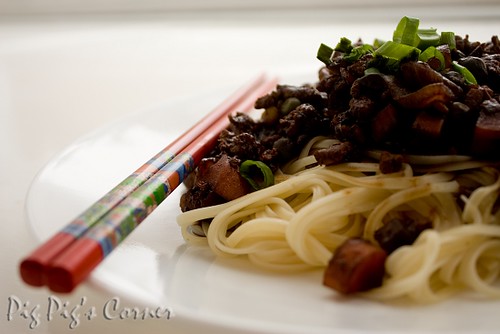
The 14th of next month, which is pathetically called Black Day, will be dedicated to the singles. But rather than being a day of celebration as it has been in the past couple months, this 14th will be marked by groups of singles gathering to eat jajang-- chinese noodles with a black sauce-- and bemoaning the misery that is their relationship status.

Oh, Korea.

Ahh, so much commercialized love all around.
The 14th of next month, which is pathetically called Black Day, will be dedicated to the singles. But rather than being a day of celebration as it has been in the past couple months, this 14th will be marked by groups of singles gathering to eat jajang-- chinese noodles with a black sauce-- and bemoaning the misery that is their relationship status.
Oh, Korea.
Tuesday, February 16, 2010
Double the Holiday Love
First of all, Happy Belated *Seolentines* Day!
For those of you who have no idea what I mean (most of you?), that would be Happy Seolal, aka Korean Lunar New Year, and Happy Valentines Day, all wrapped up in one! The two holidays happened to fall on the same day this year, which meant it was a day doubly filled with love for families and friends. And I felt particularly blessed because I had two of the people I love most in the world here to celebrate it with me. :)

*All* my love,
M.E.
For those of you who have no idea what I mean (most of you?), that would be Happy Seolal, aka Korean Lunar New Year, and Happy Valentines Day, all wrapped up in one! The two holidays happened to fall on the same day this year, which meant it was a day doubly filled with love for families and friends. And I felt particularly blessed because I had two of the people I love most in the world here to celebrate it with me. :)
Valentine's day has always been a favorite day of mine. Before you start rolling your eyes and jumping on my back for buying into the comercialized hype, let me tell you I will be the first to admit that the whole concept is completely cliched and contrived, and, in fact, my love for the holiday has nothing to do with a desire to be romanced. Rather, I simply love being given the excuse to indulge in overflowing and absurdly ridiculous amounts of girliness for one whole day out of the year. In all honesty, I think that I would probably live my entire life twirling around in a display of pink and red hearts if that were at all socially acceptable, so it is quite fortunate for me that Valentine's day provides an outlet to express my deep appreciation for ubercheesy prettiness and all things tackily feminine.
Even more importantly, though, on Valentines Day it becomes completely appropriate-- in a way that it is not on any other day of the year-- to be extravagantly effusive in expressing your affection for the people you care about, and that is something that I absolutely *love*.
Not suprisingly, Korea, with its booming "couple culture," has fully embraced this particular holiday as well. Everywhere I turned on VDay I was faced with couples in matching outfits bearing gifts of flowers and chocolates for one another. In Korea, Valentine's day in mostly an opportunity for women to shower the men in their lives with lots of love and gifts (don't worry, the men get their turn to reciprocate next month on "White Day"), but I definitely witnessed the love flowing both ways.
In spite of all this, though, Valentines day was still a bit of a sidenote this past Sunday; mainly because it was so overshadowed by the importance of Seolal. The Lunar New Year is the biggest festival day of the year here in Korea and a time for families to travel to their hometowns and spend quality time with relatives. It's akin to the way we might view and celebrate Christmas in the States. (Side note: It was particularly sweet for me to have not just distant family here with me on this Korean family holiday, but my own siblings. I know I said it once already in this post, but I cannot say enough just how grateful I am for the time they have gotten to spend here!)
The Lunar New Year is also the day that everyone in Korea officially ages one year. I thought about skipping out on the traditional ricecake soup (deok guk) that is typically eaten on the holiday, because I was always told by my mother growing up that without eating it I wouldn't be able to become a year older, but in the end I couldn't resist-- deok guk has always been one of my favoriteeee Korean foods, and I just couldn't muster up the will power.
Yum.
Ah, well... I guess being 24 is not *so* bad. And atleast now I can rest easy knowing that I have secured good fortune for myself for the rest of the year :)
M.E.
Tuesday, February 2, 2010
Guest Blogger: Ferf McFub (aka Christopher)
Shelly Nuna and I were bored because Mary Nuna had to work all day. I had told Mary Nuna that I wanted to see a whole bunch of "old stuff," so she called up her Korean friend Micah. He thought it would be cool to show us around Seoul and take us to Gyeongbuk palace.
In the morning before we left, Shelly Nuna showed me a picture of Micah, so I recognized him in the train station. It was a long train ride to the palace. Right after we bought our tickets, they were doing a changing of the guards ceremony. It was perfect timing!

My favorite thing inside the palace was the heating system. I thought it was really cool and advanced. Shelly Nuna and I climbed inside one of the fire pits.

Then we went to the Korean folk museum where we saw traditional uggs and learned about the history of kimchi.


I even tried on the traditional Korean hambok.

After we left the museum, I noticed there was an ice-skating ring. It happened to only cost one thousand won per person to skate! Super cheap!! We went skating and I fell a bunch of times.

Then we went to a King Sejong museum that was underground. I even tried on his hat.


After the end of a long and fun day, Mary Nuna met us for dinner. After dinner Mary Nuna wanted to stop by the book store (surprise, surprise). It turned out to be alright though, because Micah bought me a comic book as a gift (score!).
By the end of our adventures I was very happy to crawl in bed and fall asleep, but already looking forward to my next day trip into Seoul!
In the morning before we left, Shelly Nuna showed me a picture of Micah, so I recognized him in the train station. It was a long train ride to the palace. Right after we bought our tickets, they were doing a changing of the guards ceremony. It was perfect timing!

My favorite thing inside the palace was the heating system. I thought it was really cool and advanced. Shelly Nuna and I climbed inside one of the fire pits.

Then we went to the Korean folk museum where we saw traditional uggs and learned about the history of kimchi.


I even tried on the traditional Korean hambok.

After we left the museum, I noticed there was an ice-skating ring. It happened to only cost one thousand won per person to skate! Super cheap!! We went skating and I fell a bunch of times.

Then we went to a King Sejong museum that was underground. I even tried on his hat.


After the end of a long and fun day, Mary Nuna met us for dinner. After dinner Mary Nuna wanted to stop by the book store (surprise, surprise). It turned out to be alright though, because Micah bought me a comic book as a gift (score!).
By the end of our adventures I was very happy to crawl in bed and fall asleep, but already looking forward to my next day trip into Seoul!
Tuesday, December 15, 2009
My First Open Class
One of the unique experiences of working in a Korean public school is the fulfilment of the bi-annual "open class" requirement.
The open class is just that-- a class that is advertised and open to any and all visitors, both from within the school, and from other schools in the surrounding area. These visitors observe your "demo lesson" and stick around afterwards to offer crtiques and feedback on what they saw.
To be quite honest, I was dreading having to do this. I really enjoy teaching, but I hate anything that feels remotely like a presentation or a show. As the day of my open class neared, more experienced native teacher friends laughed at my anxiety, telling me not to worry and that it is not such a big deal, while my co-teachers were completely freaking out about it. I was more inclined to trust my Korean co-teachers-- after all, they are more familiar with the importance of the open class for our school and its purpose within the public education system here-- which probably helped me in the preparation stages, but, of course, did nothing for my nerves.
However, my first ever open class was this morning, and I survived.
The topic of my open class was "Let's Talk About Movies." Now that final exams are over for the students, I am free to choose any topic and to use any materials I can get my hands on when creating my lessons for the next month-- which is great because it allows me a level of freedom and flexibility that I ususally don't have. The not-so-great part, however, is that, since exams are over, students are not accountable for anything that they do in class and are therefore completely unmotivated to learn. So, I chose the movie topic in hopes that students would want to be engaged, since movies are something fun that they care about, and because movies would make a great topic of conversation for those who want to make English speaking friends their own age. It is a subject that actually matters to them, and luckily, it was a topic that they turned out to be relatively interested in. The class was far from smooth, but the kids stayed invested, which was huge.
After class, we had a roundtable discussion to elicit feedback from the visiting teachers from surrounding schools. The head of our English department opened the discussion by, I think, trying to discretely apologize for my co-teacher and I-- or perhaps, he was just qualifying our performace-- in saying that he had been worried about me as a "newborn teacher," and emphasizing that both my co-teacher and I had never done an open class before. He added that he was aware that open classes were for demonstration purposes, but that my co-teacher and I had wanted to demonstrate something closer to a real class. Luckily, the other teachers seemed to respond positively to the idea that what they had seen was unrehearsed, and that the lesson was therefore delivered and recieved in a natural way.
The experience overall was a good one. We were critiqued for trying to fit too much into a single class period, being too "academic," having an unbalanced division of speaking time between co-teachers, and for not being thorough enough when checking student comprehension of instructional steps. On the other hand we were commended on our choice of topic, the way that we gave immediate and positive feedback, the high participation and activity level of our students, and our good control of the class (whaattt?? that one shocked me). The visiting teachers gave us very helpful feedback on the lesson that I know is going to make me a better teacher and that I hope to be able to use to open up some avenues of discussion with my co-teachers on just how the logistics of "co-teaching" should play out.
So, after today, while I can't say that I look forward to holding another open class next semester, I now know what a valuable process it can be. I am confident that the information gleaned from the open class experience will be of great benefit to both my students and to me, and that is definitely something to embrace.
(A little side note: I really feel for my friends who are teachers in hagwons-- private language institutes-- who have to do thier open classes for their students' parents, rather than for other teachers. I have a feeling that parents would be a little less constructive in their criticisim, and are bound to view the class through a very different lens [$$] than the teacher...eek. )
The open class is just that-- a class that is advertised and open to any and all visitors, both from within the school, and from other schools in the surrounding area. These visitors observe your "demo lesson" and stick around afterwards to offer crtiques and feedback on what they saw.
To be quite honest, I was dreading having to do this. I really enjoy teaching, but I hate anything that feels remotely like a presentation or a show. As the day of my open class neared, more experienced native teacher friends laughed at my anxiety, telling me not to worry and that it is not such a big deal, while my co-teachers were completely freaking out about it. I was more inclined to trust my Korean co-teachers-- after all, they are more familiar with the importance of the open class for our school and its purpose within the public education system here-- which probably helped me in the preparation stages, but, of course, did nothing for my nerves.
However, my first ever open class was this morning, and I survived.
The topic of my open class was "Let's Talk About Movies." Now that final exams are over for the students, I am free to choose any topic and to use any materials I can get my hands on when creating my lessons for the next month-- which is great because it allows me a level of freedom and flexibility that I ususally don't have. The not-so-great part, however, is that, since exams are over, students are not accountable for anything that they do in class and are therefore completely unmotivated to learn. So, I chose the movie topic in hopes that students would want to be engaged, since movies are something fun that they care about, and because movies would make a great topic of conversation for those who want to make English speaking friends their own age. It is a subject that actually matters to them, and luckily, it was a topic that they turned out to be relatively interested in. The class was far from smooth, but the kids stayed invested, which was huge.
After class, we had a roundtable discussion to elicit feedback from the visiting teachers from surrounding schools. The head of our English department opened the discussion by, I think, trying to discretely apologize for my co-teacher and I-- or perhaps, he was just qualifying our performace-- in saying that he had been worried about me as a "newborn teacher," and emphasizing that both my co-teacher and I had never done an open class before. He added that he was aware that open classes were for demonstration purposes, but that my co-teacher and I had wanted to demonstrate something closer to a real class. Luckily, the other teachers seemed to respond positively to the idea that what they had seen was unrehearsed, and that the lesson was therefore delivered and recieved in a natural way.
The experience overall was a good one. We were critiqued for trying to fit too much into a single class period, being too "academic," having an unbalanced division of speaking time between co-teachers, and for not being thorough enough when checking student comprehension of instructional steps. On the other hand we were commended on our choice of topic, the way that we gave immediate and positive feedback, the high participation and activity level of our students, and our good control of the class (whaattt?? that one shocked me). The visiting teachers gave us very helpful feedback on the lesson that I know is going to make me a better teacher and that I hope to be able to use to open up some avenues of discussion with my co-teachers on just how the logistics of "co-teaching" should play out.
So, after today, while I can't say that I look forward to holding another open class next semester, I now know what a valuable process it can be. I am confident that the information gleaned from the open class experience will be of great benefit to both my students and to me, and that is definitely something to embrace.
(A little side note: I really feel for my friends who are teachers in hagwons-- private language institutes-- who have to do thier open classes for their students' parents, rather than for other teachers. I have a feeling that parents would be a little less constructive in their criticisim, and are bound to view the class through a very different lens [$$] than the teacher...eek. )
Tuesday, December 8, 2009
5 things...
... that I don't have the desire (or guts) to try while in Korea.
5. Going to JimJilBang-- the traditional Korean public bathhouse. It may not sound so bad to many of you, but I just can't get past the idea of walking around completely nude in front of a bunch of strangers, especially knowing how my simply being a foreigner invites so much gawking, even when I'm fully clothed.
4. Getting a pedicure by Dr. Fish... aka, having my feet mauled by flesh eating carp.
3. Eating dog... completely self-explanatory, I think.
2. Eating octopus ALIVE. While I do think this National Geographic video is a bit dramatic, it should give you a pretty adequate picture of why I don't intend to partake in this particular delicacy. Just in case you needed it.
1. Actually, I can only come up with four things... but those are more than enough, I think.
Sunday, December 6, 2009
Let's Free Hugs!
Here in Korea, it is quite common to see women walking around holding hands and men with their arms around one another's waists. Even friends who have met for the first time may be spotted walking arm in arm down the street. (Having always been a kind of touchy-feely person, this is one of the aspects of Korean culture that I loved right away.)
However, in spite of the widespread display of intimate physical affection among friends here, hugs are not especially common. In fact, even within tight-knit Korean families, hugs have generally always been reserved for life's most special and emotionally charged moments.
This is perhaps changing among younger generations of Koreans, though. Interestingly, I have noticed that giving free hugs seems to be a fairly popular phenomenon around Seoul. I've gotten free hugs twice since being here, and both times brightened my day and put a big smile on my face. I LOVE to hug!
Below is a video made by a Korean in Seoul, who was inspired after watching Juan Mann's free hug video.
And here, some foreigners from Canada, Scotland, and Japan joined in on spreading the love in Korea. I adore the songs on both videos.
The simple honesty of one comment from a viewer of the video above especially touched my heart... "So nice! For Japanese, free hug in korea seems hard but I wish I could do!"
Hugs can change hearts, and changed hearts change the world. Let's free hugs! :)
However, in spite of the widespread display of intimate physical affection among friends here, hugs are not especially common. In fact, even within tight-knit Korean families, hugs have generally always been reserved for life's most special and emotionally charged moments.
This is perhaps changing among younger generations of Koreans, though. Interestingly, I have noticed that giving free hugs seems to be a fairly popular phenomenon around Seoul. I've gotten free hugs twice since being here, and both times brightened my day and put a big smile on my face. I LOVE to hug!
Below is a video made by a Korean in Seoul, who was inspired after watching Juan Mann's free hug video.
And here, some foreigners from Canada, Scotland, and Japan joined in on spreading the love in Korea. I adore the songs on both videos.
The simple honesty of one comment from a viewer of the video above especially touched my heart... "So nice! For Japanese, free hug in korea seems hard but I wish I could do!"
Hugs can change hearts, and changed hearts change the world. Let's free hugs! :)
Friday, November 27, 2009
Late Fall is Kimchi Season

I have gotten a few requests for a more thorough post on kimchi since my arrival in Korea, and I figured that since we are currently in the throes of kimchi preparation season in the ROK, there would be no better time for me to tackle the subject.
Historically, the pickling and fermentation of cabbage and other vegetables arose from the need of an agrarian society to preserve it's main food source in order to get through the long, cold winters here on the Korean peninsula. Of course, in modern times this is no longer necessary, but the tradition of preparing for winter by making and storing pound after pound of kimchi persists-- though, now, rather than being stored underground, it is stored in special and widely popular kimchi refrigerators.
In my first post I described kimchi as a staple food of Korea, but in reality it is so much more. IMHO, kimchi qualifies as a cultural obsession among the Korean people, and serves as something of an icon for the nation. Last year, when the first Korean astronaut entered space, government research institutes spent millions of dollars developing a bacteria-free kimchi to send into orbit with him. Private and government funded websites, publications, and museums all devoted to the promotion and glorification of kimchi are plentiful, and it is suspected that the government has repressed the publication of research showing excessive consumption to be the cause of the high rate of gastric cancer found among Koreans. Kimchi is a source of national pride, and in Korea's quest to grow her cuisine's presence and popularity on the international scene, kimchi is the central tool.
Myth and speculation surrounding kimchi's ancient origins abound. Here is an example of one myth accounting for the foods' conception:
The origin of kimchi is attributed to a poor farmer who carried several old heads of cabbage to the sea to wash and freshen them. He noticed that these rather meager heads seemed to grow bulkier after sitting in the salty water, and decided he was onto something great. If a short washing in sea water made them a little heavier wouldn't an overnight soaking make them a lot heavier? His puny cabbage would become hearty and he would have more food for himself and his family. He left the cabbages to soak and returned expectantly the next morning, only to find that the pot he had left them in was half empty. He swore revenge on the cruel thief, not realizing that it was the salt in the water that had brought about the change in the contents of the pot and not a criminal. Perhaps driven by dispair, the farmer tore off a leaf from the wilted cabbage heads and popped it in his mouth. Yummmmm! Kimchi was born...There are other stories like this one floating around, but, however it is that kimchi actually came about, there is no mistaking the food's importance in Korea, nor the value that Koreans have placed on it, both historically and today. Here's a little taste of kimchi propoganda:
The trailer below was linked to from LoveThatKimchi.com, one of many websites and blogs devoted to the food. Apparently this "Kimchi Khan" documentary has been 20 years in the making.
The article on wikipedia will tell you most of anything else that you might want to know-- and I am a lazy blogger-- so I will simply conclude by sharing with you pictures and recipes for my own top 5 favorite types of kimchi. Enjoy :)
1. Baechu Kimchi: Nappa cabbage kimchi, the most common variety
Recipie found at whats4eats.com
Makes about 2 quarts

- Chinese cabbage, outer leaves removed, cut into 1-inch squares -- 1 head, or 2 1/2 to 3 pounds
- Kosher or sea salt -- 1/2 cup
- Scallions, finely chopped -- 4-6
- Garlic, minced -- 2-4 cloves
- Ginger, minced -- 1 tablespoon
- Korean chili flakes -- 4-6 tablespoons
- Sugar -- 1 tablespoon
Method
- Add the cabbage and salt to a large glass or plastic bowl and toss together well with clean hands. Cover with plastic wrap and set aside for 2-5 hours.
- Place the cabbage—which should now be soft—in a colander. Rinse out the bowl and then rinse the cabbage well with water. Squeeze out excess water and return cabbage to the bowl. This step removes excess salt.
- Add the remaining ingredients and stir together with a wooden spoon. Place into a larg,, clean glass or plastic crock, container or jar and tamp down to remove any air bubbles. Cover with a lid and let set in a cool, dark place for 2-3 days.
- Transfer to a new container and store refrigerated for up to two weeks.
2. Chonggak Kimchi: Ponytail raddish kimchi-- also called "bachelor kimchi"
Recipe from yum-recipes.com
Ingredients
| 3 | bn | Korean ponytail radishes |
| 1 | cup | salt plus |
| 1 | tbl | salt |
| 1 | head | garlic |
| 2 | piece | ginger root - (ea 1" long) peeled |
| 1 | bn | green onions cut 1" slices |
| 1/2 | cup | Korean ground chile |
| 1 | tbl | salted shrimp |
Instructions:
Peel radishes, taking care to leave green stalks attached.

Wash radishes thoroughly.
Drain in colander. Place on baking sheet and sprinkle with 1 cup salt.
Mix and let sit 30 minutes.
Separate garlic cloves and peel.
Place garlic and ginger in food processor or blender and mince.
Combine garlic mixture with green onions, chile, salted shrimp and 1 tablespoon salt.
(If mixing with your hands, be sure to wear gloves to avoid chili burn.
)Rinse salt from radishes.
Drain in colander. Rub seasoning mix onto radishes.
Set 2 (1-quart) jars on work surface.
Divide radishes among jars.
Let sit 2 to 3 days before serving.
Refrigerate after opening.
This recipe yields 2 quarts.
3. Oi Sobagi: stuffed cucumber kimchi, especially popular in spring and summer
Recipe from Chow.com
Ingredients

6 medium unwaxed cucumbers
2 tablespoons salt
1 bunch chives
6 green onions
1 small Daikon radish
Seasoning Paste
4 cloves garlic
1/2 small white or yellow onion
1 inch fresh ginger
1 tablespoon salt
3 tablespoons medium ground red chili pepper
1 tablespoon fine ground red chili pepper
1 teaspoon sugar
Optional
1 teaspoon shrimp paste
Instructions
- Prepare the Cucumbers–Cut cucumbers in half across the middle.
Slice the cucumber sections in half lengthwise, leaving the last 1/4 inch uncut.
Turn the cucumber section half way and repeat.
Lightly salt the inside surfaces and let stand for at least twenty minutes. Rinse, drain, and place in a large non metallic mixing bowl. - Prepare the vegetables–Grate or shred the Daikon and lightly salt.
Fine chop the green onion - Mix the Seasoning Paste–Place the garlic, onion half, and ginger into a blender with just enough water to blend into thick smooth paste. Pour into a medium non metallic mixing bowl.
Add all other seasoning ingredients and mix well. Add water as needed to maintain a thick paste.
Add chive, daikon, and green onion, mix well.
Let stand fifteen to twenty minutes. - Stuff Cucumber–Carefully stuff the seasoning paste into the slotted cucumber. Be careful not to break the uncut ends.
Place stuffed cucumber into a large glass container, cover tightly, and let stand at least one hour.
Refrigerate and serve cold with your favorite Korean meal.
4. Dongchimi: White radish kimchi, vinegary rather than spicy
Recipe from koreanfood.about.com
Ingredients:

- 8 Medium Korean radishes (if you can't find, use Daikon), peeled and sliced into 1 inch pieces
- 6 Tbsp sea salt
- 4 Tbsp sugar
- 4 cloves of garlic, peeled and thinly sliced
- 3-4 green onions, sliced into 2 inch pieces
- 10 cups of water (about 2 quarts)
- Carrots, chili peppers, or Asian pears (optional)
- Coat radishes with 3 Tbsp of salt and 2 Tbsp of sugar. Let stand for 1 day at room temp.
- After 1 day, dissolve 3 Tbsp of salt and 2 Tbsp of sugar into warm water.
- Add liquid to salted radishes, garlic, green onions, and any other vegetables you are using. Let stand for 1-2 days at room temp.
- When broth has achieved a tart, vinegary flavor, store in refrigerator.
- To serve, ladle vegetables and generous amount of broth into a cup or small bowl.
5. Pa Kimchi: Green onion kimchi
Recipe from korean-cuisine.blogspot.com

Ingredients:
- 5 dans of jjook pa
- 1 CUP red pepper powder
- 1.5 TB sugar
- 2 TB honey powder
- 3 TB gga-nari fish sauce
- 1 TB fish sauce
- 3 TB rice wine
- 6 TB water
- 1 TB sesame seeds
- 0.5 TB salt
Mix together the ingredients listed above: 1 CUP red pepper powder,1.5 TB sugar, 2 TB honey powder, 3 TB gga-nari fish sauce, 1 TB fish sauce, 3 TB rice wine, 6 TB water, 1 TB sesame seeds, 0.5 TB ginger powder, and 0.5 TB salt.
Work the pepper mixture into the pa in thirds. Get 1/3 of the pa and 1/3 of the mixture and mix, and so on...
Once everything is mixed in well, let it sit for about 10-15 minutes. This will make the pa soft and much more easier to store.
Finally, store in a container overnight and then let it ferment inside the fridge for a few days.
After a few days it will be ready to serve!
Monday, November 16, 2009
Introducing HAECHI!
Introducing Haechi, the iconic symbol associated with the vibrant, thriving and inviting international city of Seoul.
Atleast, that is what the mayor of the city is hoping he will soon come to represent.
This article reporting on the release of Haechi as the chosen icon for Seoul last year states that the mayor "wants Haechi to become like the Big Apple of New York, Merloin in Singarpore and Buddy Bear of Berlin." He even promotes referring to Seoul as "The City of Haechi."
So, as a lover of Korea's capital, I am now officially doing my part to promote Seoul's international image by presenting the lovable icon to you, my dear family and friends.
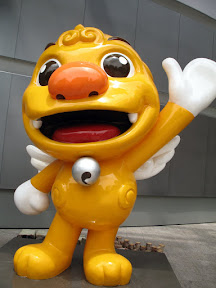
Cute, right? And who would ever guess that he is also a fierce defender of justice and peace?
In the picture below, I am posing at Gyeongbok palace in Seoul with Haechi's forefather, traditionally known as Haetae-- a figure from Korean and Chinese mythology that guards against disaster and injustice. He has the body of a lion with the horned head of a fire-eating dog. The particular Haetae pictured below was placed outside of the Joseon dynasty-era palace to serve as protector of king and city.

As you can see from the following images, however, Haechi has recently also taken on some slightly different and more varied duties:

Obviously, I am completely in love with the little guy; he is hands down the cutest fire-eating dog I have ever seen. I wonder where I could find myself a stuffed Haechi-- that's going on the to-do list for sure...
Atleast, that is what the mayor of the city is hoping he will soon come to represent.
This article reporting on the release of Haechi as the chosen icon for Seoul last year states that the mayor "wants Haechi to become like the Big Apple of New York, Merloin in Singarpore and Buddy Bear of Berlin." He even promotes referring to Seoul as "The City of Haechi."
So, as a lover of Korea's capital, I am now officially doing my part to promote Seoul's international image by presenting the lovable icon to you, my dear family and friends.
Cute, right? And who would ever guess that he is also a fierce defender of justice and peace?
In the picture below, I am posing at Gyeongbok palace in Seoul with Haechi's forefather, traditionally known as Haetae-- a figure from Korean and Chinese mythology that guards against disaster and injustice. He has the body of a lion with the horned head of a fire-eating dog. The particular Haetae pictured below was placed outside of the Joseon dynasty-era palace to serve as protector of king and city.

As you can see from the following images, however, Haechi has recently also taken on some slightly different and more varied duties:
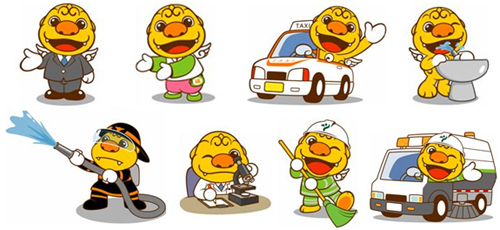
Obviously, I am completely in love with the little guy; he is hands down the cutest fire-eating dog I have ever seen. I wonder where I could find myself a stuffed Haechi-- that's going on the to-do list for sure...
Friday, November 13, 2009
I ♥ 콩글리시
콩글리시 or Konglish (Korean+English) is a well worn term within Korean and expatriate communities alike that refers to a phenomenon that anyone who has ever traveled to Korea-- or to any number of other countries throughout Asia-- is certainly familiar with. Everywhere you turn here in the ROK you can see English words used in entertainment and advertising, on clothing, and in everyday conversation. Sometimes these words are actual English words, other times they are "Korean-ized" versions of English words, and still other times they are English words creatively melded together with Korean words. Often the words mean something different to Koreans than they would to a native English speaker. And in sentences that employ Konglish, I would say that, more often than not, there are what would generally be considered by native speakers to be significant mistakes in sentence structure and usage.
Click on the video below to listen to an older but still classic K-pop song that beautifully demonstrates Konglish in action...
Just google "konglish" and click on images to see plenty more examples-- Konglish can be found on everything from billboards, to street signs, to clothing and other goods.
Usually when I have heard the term Konglish used by Koreans here in Korea, I have sensed an undercurrent of self-criticism and bitterness in their generally light and teasing tone. Whether or not this is usually the case when Koreans mention Konglish, though, I really can't say. I am a foreigner, and it is therefore assumed that I will in some way think less of them for "misusing" the English language-- an assumption which undoubtedly colors the way Koreans express themselves around me. After all, one of the major motivating factors for bringing native English speaking teachers into public schools in the first place is to try to halt the transfer of commonly made mistakes in usage and grammar from the Korean teacher to student. There seems to be a big fear here that the use of Konglish in foreign environments will bring shame on both the individual who uses it and on Korea in general.
Without weighing into the debate on whether or not Konglish is a good or bad thing for Korean culture, whether it's use is beneficial or whether it's purpose is valid, I am simply going to say that I personally love Konglish. I think it's often creative, inventive, clever and charming. I mean, "if you wanna pretty, every wanna pretty"? How cute is that?
Now, I am certain that there are varieties of Konglish that do much more harm than good, and I want to be clear that I am not attempting to dismiss the fact that there may be real problems that both undergird and arise from the widespread use of incorrect and sometimes nonsensical English. Neither do I want to minimize the counter arguments that insist on the meaningfulness and value of what might seem to be gibberish to the native speaker in the Korean context. All I mean to state here is simply that, even after being in Korea for nearly three and a half months, hearing Konglish still warms my heart and makes me want to smile.
I suspect that my soft spot for Konglish is mainly due to the fact that hearing it makes me feel at home here in Korea. While I may not be able to understand much actual Korean, I have no problem at all with understanding Konglish. My own mother and grandmother are, after all, expert users of the sub-language, and that has made me, in turn, an expert interpreter.
Of course, Konglish is nothing if not constantly evolving, and being in Korea has given me a Konglish education that I never could have gotten at home. Two of my newest personal favorite terms are "paiting," aka fighting-- a word to be yelled at sporting events in a similar way that some might yell "Victory!"; and "grlamor," aka glamour-- used to mean something like sexy and curvy, as in "Beyonce is so grlamor."
For now, suffice it to say, I think you can expect many more posts devoted to celebrating the joy that is Konglish coming from me in the future...
Click on the video below to listen to an older but still classic K-pop song that beautifully demonstrates Konglish in action...
Just google "konglish" and click on images to see plenty more examples-- Konglish can be found on everything from billboards, to street signs, to clothing and other goods.
Usually when I have heard the term Konglish used by Koreans here in Korea, I have sensed an undercurrent of self-criticism and bitterness in their generally light and teasing tone. Whether or not this is usually the case when Koreans mention Konglish, though, I really can't say. I am a foreigner, and it is therefore assumed that I will in some way think less of them for "misusing" the English language-- an assumption which undoubtedly colors the way Koreans express themselves around me. After all, one of the major motivating factors for bringing native English speaking teachers into public schools in the first place is to try to halt the transfer of commonly made mistakes in usage and grammar from the Korean teacher to student. There seems to be a big fear here that the use of Konglish in foreign environments will bring shame on both the individual who uses it and on Korea in general.
Without weighing into the debate on whether or not Konglish is a good or bad thing for Korean culture, whether it's use is beneficial or whether it's purpose is valid, I am simply going to say that I personally love Konglish. I think it's often creative, inventive, clever and charming. I mean, "if you wanna pretty, every wanna pretty"? How cute is that?
Now, I am certain that there are varieties of Konglish that do much more harm than good, and I want to be clear that I am not attempting to dismiss the fact that there may be real problems that both undergird and arise from the widespread use of incorrect and sometimes nonsensical English. Neither do I want to minimize the counter arguments that insist on the meaningfulness and value of what might seem to be gibberish to the native speaker in the Korean context. All I mean to state here is simply that, even after being in Korea for nearly three and a half months, hearing Konglish still warms my heart and makes me want to smile.
I suspect that my soft spot for Konglish is mainly due to the fact that hearing it makes me feel at home here in Korea. While I may not be able to understand much actual Korean, I have no problem at all with understanding Konglish. My own mother and grandmother are, after all, expert users of the sub-language, and that has made me, in turn, an expert interpreter.
Of course, Konglish is nothing if not constantly evolving, and being in Korea has given me a Konglish education that I never could have gotten at home. Two of my newest personal favorite terms are "paiting," aka fighting-- a word to be yelled at sporting events in a similar way that some might yell "Victory!"; and "grlamor," aka glamour-- used to mean something like sexy and curvy, as in "Beyonce is so grlamor."
For now, suffice it to say, I think you can expect many more posts devoted to celebrating the joy that is Konglish coming from me in the future...
Subscribe to:
Posts (Atom)